

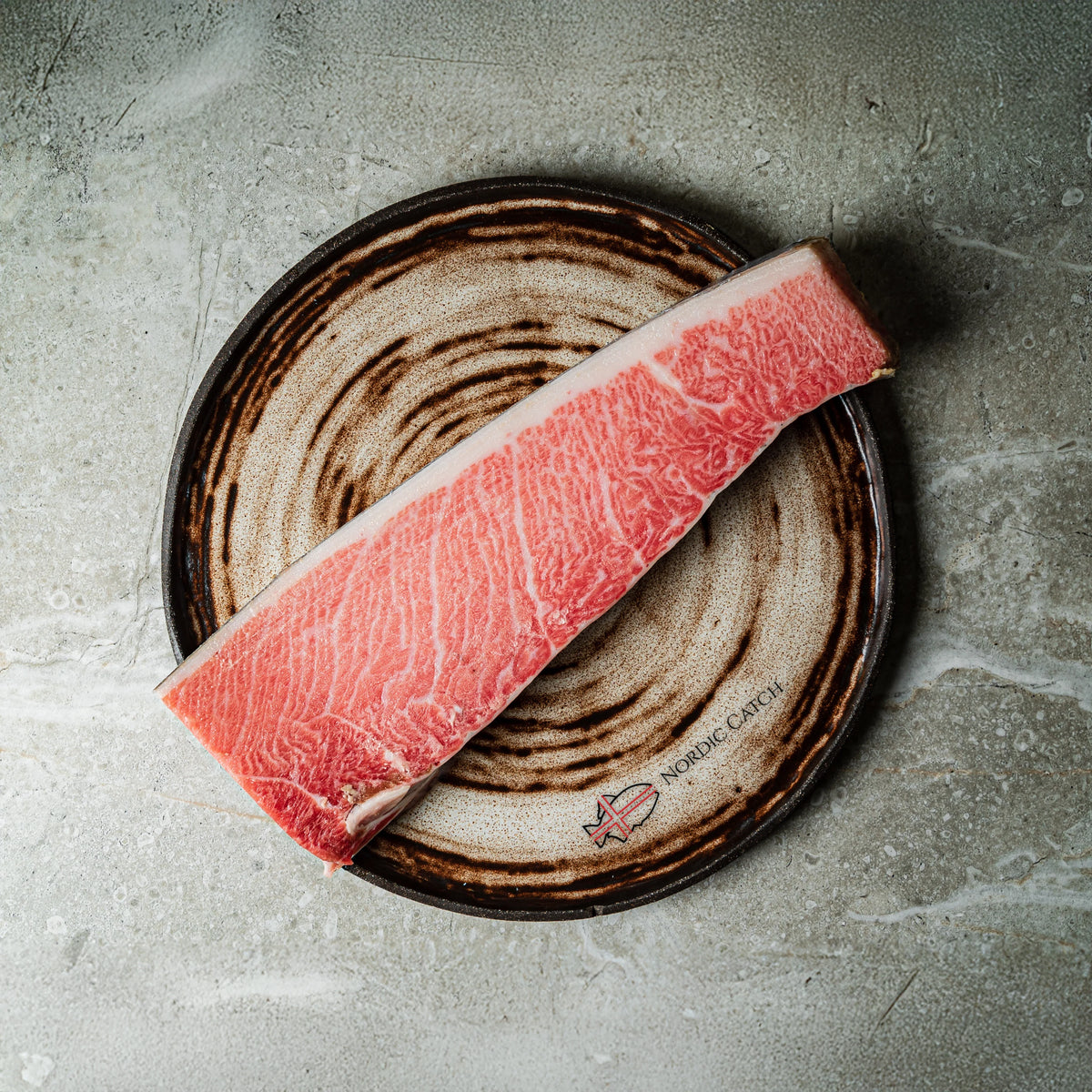
A block of otoro arrives looking like a cut of well-marbled beef: pale pink, laced with white fat, heavy in the hand. You will want to slice it the moment the box opens. Wait. A restaurant otoro course or a plate of torn, smeared pieces is decided in two places, the fridge where the block thaws and the single pull of the knife that follows. This how-to covers both, then nigiri and plating.
We are working with our Otoro Bluefin Tuna Belly for Sashimi, a 1.5 to 2 pound harakami block for $225. Harakami is the front belly near the head, where the marbling is most concentrated. Our product page lists bluefin from Spain's responsibly managed fisheries, harvested under ICCAT quotas and ultra-frozen at peak freshness.
Bluefin flesh is the darkest and fattiest of any tuna, and that fat is why it is prized for sushi and sashimi (NOAA Fisheries). It also makes otoro unforgiving. The fat softens quickly at room temperature, smears under a dull edge, and changes color in a regular freezer, so our product page says to keep the block on dry ice and thaw it under refrigeration only.
Plan for an overnight thaw and about 20 minutes of knife work. One block gives you a sashimi course for six, or nigiri with trim left for a hand roll. Nothing is cooked, so the skill is restraint.
Otoro Sashimi Tools & Ingredients
Otoro needs almost nothing added. Everything here keeps the fish cold, the knife clean, and the toro tuna center stage. Your otoro tuna is our Otoro bluefin tuna belly, a 1.5 to 2 pound harakami block; the same harakami cut of bluefin tuna belly also comes as an 11 oz portion for $95.
- 1.5-2 lbOtoro bluefin tuna belly, harakami block, thawed in the fridgeFeatured
- 2 cupsCooked sushi rice, seasoned, body temperature (for nigiri)
- 1 rootFresh Japanese wasabi root, grated to order
- 2 tbspSoy sauce, on the side
- 1/4 cupWater with a splash of rice vinegar, for your hands
- PinchFlaky sea salt and a lemon wedge
- 1Long, very sharp slicing knife (yanagiba or long chef's knife)
- 1Cutting board on a damp towel
- 1Roll of paper towels
- 1Serving plate, chilled 10 minutes
- 1Fine wasabi grater (sharkskin or steel)
- 1Small bowl for the hand water
Sushi grade is a marketing term, not a U.S. grade. Raw safety rests on species, parasite-destruction freezing where it applies, and an unbroken cold chain. Section 3-402.11 of the FDA Food Code 2022 says fish served raw in restaurants and stores must first be "frozen and stored at a temperature of -20C (-4F) or below for a minimum of 168 hours (7 days)," or frozen at -35C (-31F) or below until solid, then held at -35C (-31F) for 15 hours or at -20C (-4F) for 24 hours. It exempts six tuna species, among them "Thunnus thynnus (Bluefin tuna, Northern)." Our block is ultra-frozen regardless, but freezing does not kill all harmful germs, so keep the fish at 40F or below and eat it as soon as it thaws. Per the FDA, pregnant women, children, older adults and people with weakened immune systems should avoid raw fish (FDA).
How to Slice Otoro Step by Step
Here is how to cut sashimi from a whole otoro block: thaw, dry, orient, slice, shape, serve. Otoro sashimi and toro nigiri come from the same slices. Only the thickness and the rice change.
-
1
Thaw the Otoro Block in the Fridge
8 to 12 hrThe evening before, take the block out of any vacuum bag, set it on a plate, cover it loosely, and put it on the bottom shelf of the fridge. The FDA Food Code (3-501.13) has kitchens remove frozen fish from reduced-oxygen packaging before thawing it under refrigeration. Our product page covers the rest: thaw under refrigeration only, eat within 2 days of delivery, and consume immediately after thawing. FDA consumer advice also says to thaw seafood in the fridge overnight (FDA). Never thaw otoro on the counter or in warm water.
Ready looks like this: the block bends slightly under a thumb, with no hard ice at the center but a middle still firm and very cold. That chill is what gives clean slices.
Avoid quick thawingFDA allows a sealed bag in cold water for most seafood, but our product page says to thaw this cut under refrigeration only. Start it the night before. -
2
Pat Dry & Find the Grain
3 minPour off any liquid on the plate and pat the block dry on every face with paper towels. A wet surface drags on the blade. Now look at the block: white lines of fat and connective tissue run through it in sheets, and those sheets are the grain. Turn it so the lines run left to right in front of you, thinner edge away from you.
Trim a thick band of sinew on an outside face in one shallow pass and save it for a hand roll.

Harakami (12), the front belly, is the otoro section. Haranaka (11) is marked otoro to chutoro, sections 4, 6, 8 and 10 are chutoro, and akami (7) is the lean center. Avoid over-trimmingRemove only sinew you can see on the outside. The thin white lines inside the block are the point. -
3
Slice Otoro Sashimi Against the Grain
8 minOur product page gives the rule in one line: slice against the grain with a very sharp knife. Wipe the blade with a damp towel. Set the heel of the knife at the far edge of the block and draw it toward you in one long pull. Do not saw. Each slice of toro sashimi should be about a quarter inch thick and two fingers wide, with the fat lines showing as short white strokes across the pink face; that tells you the cut went across the grain. Wipe the blade every few slices, because fat on the steel tears the next piece.
Lay the slices on the chilled plate as you go, slightly overlapping, and return the plate to the fridge between batches. For nigiri, cut a touch thinner and longer.

A lean tuna saku block is shown, not otoro. The knife work is the same. Chef's TipIf a slice smears instead of separating, the block has warmed. Give it 15 minutes in the fridge and continue. -
4
Shape Toro Nigiri
5 minWet your fingertips in the hand water. Press a piece of rice about the size of the top two joints of your thumb into a light oval, firm enough to hold and loose enough to fall apart in the mouth. Smear a little grated wasabi on one side of an otoro slice, lay it over the rice, and press once with two fingers. Your toro nigiri is done when the slice hangs just past the rice at both ends.
Two or three shallow scores across the top with the knife tip help a soft otoro slice lie flat. Shape only as many pieces as you will serve right away.

Shallow scores keep a soft otoro slice flat on the rice. Avoid cold riceRice from the fridge hardens and fights the fat. Hold it at body temperature under a damp towel. -
5
Serve Otoro Cold
2 minTake the plate out of the fridge about five minutes before serving, so the fat is cold but no longer stiff. Otoro should feel cool on the tongue and then melt. Serve with grated wasabi beside the fish and soy in a small dish, never poured over it.
Eat within the half hour and do not keep leftovers. Our product page asks that the fish be eaten immediately after thawing, and FDA's 2-hour limit for perishable food applies at the table.

Four slices, a leaf, wasabi. Nothing else.
How to Serve Otoro Sushi
Otoro sushi is a short course, not a platter. Many sushi counters serve fatty tuna late in the meal, after leaner fish, so the richest bite comes last. Copy that order at home: akami or salmon first, otoro last.
Keep the seasoning at the minimum, as our product page advises, so the richness stays the focus: a grating of fresh Japanese wasabi root between the rice and the fish, a brush of soy on the fish rather than a dip, and nothing else. Real wasabi (Wasabia japonica) has a smooth, short-lived heat that rises quickly and fades, which suits a cut this rich. Grate it just before serving and let it rest a minute or two.
Three ways to serve the same slices:
- Sashimi course. Four slices per person on a chilled plate, wasabi on the side. Try flaky salt and a drop of lemon on one slice.
- Toro nigiri. Two pieces per person, served the moment they are shaped. For aburi otoro, see the FAQ.
- Toro hand roll. Chop the trim with a little soy and scallion and roll it in nori with warm rice.
Otoro Mistakes to Avoid
Most otoro that disappoints at home was handled well right up to one of these four moments.
- Storing it in the kitchen freezer. Our product page is explicit: this cut needs ultra-cold storage at -60C (-76F), which a home freezer cannot reach, and a regular freezer causes rapid color and texture changes. Keep it on dry ice and eat it within 2 days of delivery.
- Thawing on the counter. Edges soften and weep fat while the center stays frozen, and the surface spends hours above 40F. Fridge only.
- Sawing with a dull knife. A back-and-forth stroke tears the fat seams and leaves a ragged face. One pull per slice with a long, sharp blade.
- Drowning it in soy. Otoro dipped into a full dish of soy tastes of salt and little else. Brush the fish lightly instead.
None of these take skill to avoid. They take a decision to thaw in the fridge, cut cold, and eat that day.
Bluefin Otoro FAQ
What Is Otoro?
What Is the Difference Between Otoro & Chutoro?
Why Is Otoro So Expensive?
Can You Sear Otoro?
Relevant Posts
 Guide
Yellowfin Tuna Vs. Bluefin Tuna: Understanding Key Differences
 Guide
Sashimi vs Sushi: What’s The Difference?
 Guide
How Long Sushi-Grade Fish Can Stay in the Fridge Safely
 Guide
How to Choose Sushi-Grade Seafood
 Recipe
Yellowtail (Hamachi) Crudo in 15 Minutes
 Recipe
Sushi-Grade Ahi Tuna Poke Bowl at Home