

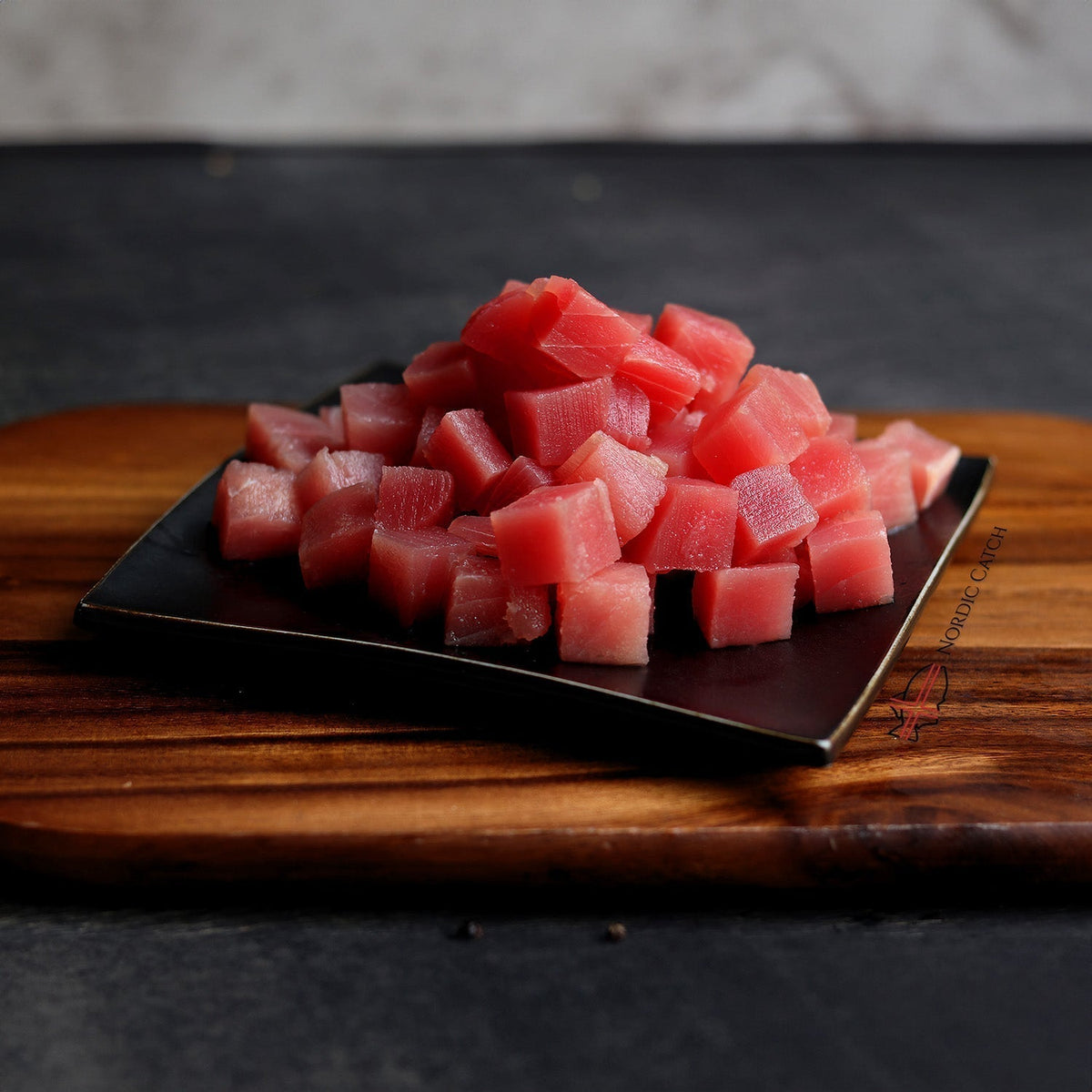
Poke is the one recipe on this site with nothing to cook. There is no sear to time and no doneness window to hit. That makes it easier than it looks and less forgiving than it sounds, because the fish is the dish. Every shortcut shows up on the fork: a cheaper grade of tuna, a bad thaw, a sauce that sat on the fish for an hour. Get two things right, the fish you start with and the ratio of the sauce, and the rest is assembly. This post is about those two things.
A word on where this comes from. Poke means to slice or cut crosswise in Hawaiian. Long before it was a bowl, it was how Hawaiian fishermen used the day's catch: reef fish cut into pieces and seasoned with sea salt, limu (seaweed) and inamona, a relish of roasted, crushed kukui nut. Shoyu and sesame oil arrived later through Japanese immigrant cooking, and shoyu ahi poke is now what most people in Hawaii mean by the word. The mainland poke bowl, on seasoned sushi rice with avocado, cucumber and spicy mayo, is much newer. It is a good dish, just not the whole story. This recipe is a shoyu ahi poke served bowl style.
Now the fish. This recipe uses our Wild Ahi Tuna Sushi Poke Cubes, AAA grade, wild yellowfin already cut to poke size and shipped overnight on ice. Ahi is the Hawaiian name for yellowfin and bigeye tuna. When you open the pack you want a deep, translucent red to pink-red color, a glossy surface, cubes that spring back when pressed, and a smell of clean ocean and little else. You do not want brown or gray edges, a dull matte surface, liquid pooling in the pack, or a strong fishy smell. Those are the same cues you would use at any counter, covered in detail in our guide to choosing sushi-grade seafood. If you would rather cut your own from a saku block, the preparation section covers how.
On safety, plainly. Sushi grade is not a legally defined term in the United States. No agency certifies it. What the FDA does publish is a freezing standard for fish served raw: held at -4F or below for 7 days, or frozen at -31F until solid and held there for 15 hours, to destroy parasites (FDA Food Code, section 3-402.11). The same section exempts the major tuna species, yellowfin included, because tuna carries a very low parasite risk. So with ahi the real question is handling: how cold the fish stayed from the boat to your fridge, and how cold you keep it at home. That is why we control our own cold chain and ship overnight. Freezing does not kill bacteria, so the fish stays in your fridge until the last fifteen minutes. And per the FDA, pregnant women, young children, older adults and anyone with a weakened immune system should skip raw fish altogether (FDA seafood safety guidance). For them, sear the cubes and serve the same bowl warm.
When to make it: a weeknight, because 45 minutes on the card is mostly rice cooking and cooling while you do nothing. The sauce is three parts shoyu to one part toasted sesame oil, plus sweet onion and scallion. The fish goes into that sauce no more than 10 to 15 minutes before you eat, which is the single rule that separates glossy poke from mushy poke. This serves two generously with 8 ounces of tuna each; use half the pack for a lighter dinner or a starter for four. New to raw fish at home? Read our guide to fresh seafood first so you know what a good pack looks like.
Nutrition
This bowl is high in protein and low in saturated fat, and most of the sodium sits in the shoyu and the rice seasoning rather than the fish. Yellowfin is one of the leanest tunas: about 109 calories and 24 grams of protein per 100 grams raw, with under half a gram of fat, per USDA FoodData Central. It is also a strong source of selenium, niacin and vitamin B12. The rice carries almost all the carbohydrate, and the avocado and sesame oil carry most of the fat. Swap to a low-sodium shoyu and you cut the sodium by roughly a third. For how ahi compares to other fish, see our ranking of the highest-protein seafoods. Estimated values per serving, whole bowl including rice and toppings:
| Fats | % DV* |
| Total Fat 18g | 23% |
| Saturated 3g | 15% |
| Trans 0g | |
| Polyunsaturated 4g | |
| Monounsaturated 9g | |
| Cholesterol 89mg | 30% |
| Sodium 1,560mg | 68% |
| Carbs, Protein & Micronutrients | % DV* |
| Total Carbohydrate 99g | 36% |
| Dietary Fiber 6g | 21% |
| Total Sugars 10g | |
| Protein 64g | 128% |
| Vitamin B12 4.7mcg | 195% |
| Selenium 206mcg | 375% |
| Potassium 1,650mg | 35% |
Ingredients
- 16oz pack Wild Ahi Tuna Sushi Poke Cubes, AAA gradeFeatured
- 1 cup Short-grain sushi rice, uncooked
- 2 tbsp + 1 tbsp + 1/2 tsp Rice vinegar, sugar and salt, for seasoning the rice
- 2 tbsp Shoyu (Japanese soy sauce)
- 2 tsp Toasted sesame oil
- 1/2 cup Sweet onion (Maui or Vidalia), sliced paper thin
- 2 + 1 tbsp Scallions, sliced, plus toasted sesame seeds
- 1 + 1/2 Avocado and cucumber, for the bowl
Preparation
Order of operations matters more here than in any cooked recipe. Rice first, because it has to cook and then cool to room temperature. Sauce and onion second. Fish last, and it does not leave the fridge until the rice is cool and the sauce is mixed. The mistake most home cooks make is dressing the fish early to let it marinate. Poke is not a marinade. The salt in shoyu pulls moisture out of the cut surface, and within an hour the cubes go from glossy and translucent to opaque and soft at the edges. Tuna that cost you $26 starts eating like something from a can. Ten to fifteen minutes in the sauce is the window. If you bought the fish frozen, or you are working from a saku block that arrived frozen, thaw it overnight in the fridge on a plate, never on the counter or under warm water. Our thawing guide explains why the slow route protects the texture.
If you are cutting your own cubes from a saku block, chill the block in the fridge for 15 minutes first. Cold, firm fish cuts cleanly; fish at room temperature smears. Pat it dry and look at the grain, the faint lines running the length of the block. You want to cut across those lines, not along them, so each cube has short fibers and a tender bite. Cut the block into 3/4 inch slabs, lay the slabs flat, cut 3/4 inch strips, then cut across the strips into cubes. Use a long, single pull of the knife from heel to tip for each cut. Do not saw. Sawing tears the flesh and leaves a ragged surface that turns to mush in the sauce. Wipe the blade between cuts if it drags. Before the fish comes out, have all of this done:
- Rinse 1 cup of sushi rice until the water runs mostly clear, then cook it.
- Stir together the rice seasoning: 2 tablespoons rice vinegar, 1 tablespoon sugar, 1/2 teaspoon salt.
- Slice the sweet onion paper thin and the scallions on a bias.
- Halve, pit and slice the avocado; cut the cucumber into thin half moons.
- Put a metal or glass mixing bowl in the fridge for the fish.
- Leave the tuna sealed in the fridge until the rice is at room temperature.
How to Cook
Nothing here touches heat except the rice, which is why the cook time on the card is really rice time. Read all four steps before you start. The order matters more than any single technique, and the one rule that cannot bend is that the rice is at room temperature before the fish comes out of the fridge.
-
Cook and season the rice
Put the rinsed rice and 1 1/4 cups of water in a small pot. Bring it to a boil, cover, drop to the lowest heat and cook 13 minutes. Off the heat, rest covered 10 minutes. Turn it out into a wide bowl, pour the vinegar seasoning over and fold with a cutting motion so the grains stay whole. Hot rice absorbs seasoning; cold rice just gets wet. Spread it out to cool to room temperature, because warm rice under raw fish warms the fish. The grains should look glossy and separate, not sticky in a lump.
-
Mix the sauce and onion
In a small bowl, stir 2 tablespoons of shoyu with 2 teaspoons of toasted sesame oil. That three to one ratio is the whole recipe. More oil goes greasy; more shoyu goes salty and flat. Add the sliced sweet onion and half the scallions and let them sit 5 minutes so the salt softens the onion's bite. Traditional poke used sea salt, limu and inamona instead; if you can find limu, add a tablespoon. Taste it: savory, nutty, faintly sweet, never sharp. Short on time: Big Aloha poke sauce does this in one pour.
-
Dress the fish
No more than 15 minutes before you eat. Open the pack and pat the cubes dry with paper towel so the sauce clings instead of sliding off. Put them in the chilled bowl, pour the sauce and onion over, and fold gently with a spoon, three or four turns. Back into the fridge until you plate. The cubes should stay glossy, translucent red and springy; once they turn opaque and matte at the edges, the sauce has been on too long. Nothing is cooked, so there is no internal temperature to reach. Cold and time are your only two controls: keep the fish at or below 40F until it hits the bowl.
-
Build the bowl
Divide the cooled rice between two wide bowls. Lay the cucumber on one side and fan the avocado on the other. Spoon the tuna and onion into the center, then pour whatever sauce is left in the bowl over the rice, not the fish, so the tuna is not sitting in liquid. Finish with the toasted sesame seeds and the remaining scallion. Eat right away. Poke does not wait; the bowl is at its best in the first ten minutes, while the fish is cold and the onion still has some crunch.
How to Serve
Poke wants contrast. Cold fish, room-temperature rice, something crunchy, something creamy, something sharp. Go easy on the extras. If you cannot taste the tuna under the toppings, you bought good fish for nothing. Build the bowl so the fish is the center and everything else frames it.
- Season the rice, not the fish, if the bowl needs more salt. The shoyu has already done that job on the tuna.
- A squeeze of lime or a few drops of yuzu over the finished bowl lifts the sesame oil without changing the poke itself.
- For heat, a little sambal, a pinch of shichimi togarashi or a sliced Hawaiian chili pepper. Spicy mayo is a mainland move and fine if you like it, but taste the plain poke first.
What to serve it with. Keep the plate simple and lean cold:
- Blanched edamame tossed with flaky salt
- Quick pickled cucumber (rice vinegar, a pinch of sugar and salt, 10 minutes)
- Seaweed salad, or a sheet of toasted nori torn over the top
- A cold lager, a dry Riesling or iced green tea
Dressed poke does not keep. Eat it the day you make it. If you must hold it, cover it in the coldest part of the fridge and finish it within 24 hours, knowing the color will dull and the texture will soften. The better plan is to dress only what you will eat and keep the undressed cubes sealed in their pack in the coldest spot of the fridge for the next day. If you still have undressed tuna on day two, sear it: a hot pan, about 60 seconds per side, rare in the center, over the leftover rice. Seasoned rice keeps two days covered in the fridge. Bring it back to room temperature before serving, or warm it briefly under a damp towel so it does not dry out.


