


Most tuna tartare recipes exist to rescue lean fish. Sesame oil, mayonnaise, chili and avocado all go into the bowl to give akami the richness it lacks. Otoro arrives with that richness built in, so this recipe runs the other way. Add almost nothing, and put the effort into keeping a very soft fat in clean cubes until it reaches the plate.
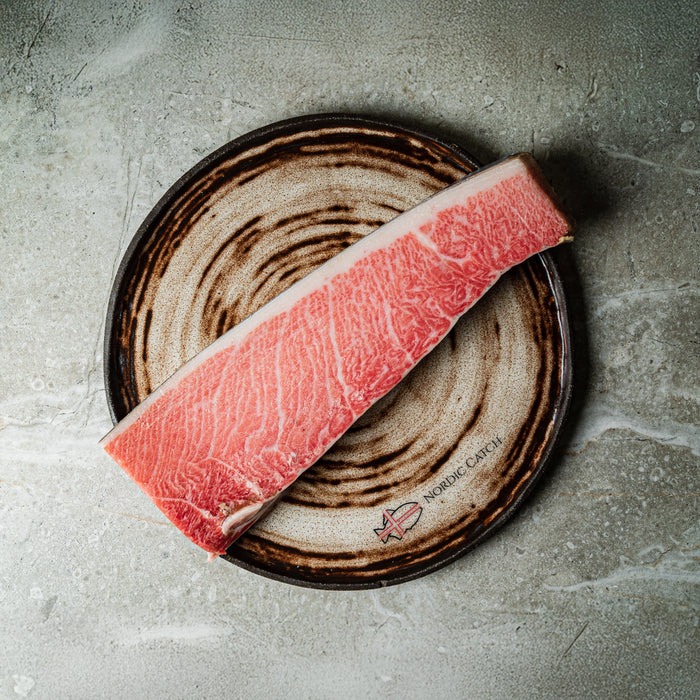
It is built on our Otoro Bluefin Tuna Belly for Sashimi, the 11 oz portion at $95. Its product page lists Atlantic bluefin, Thunnus thynnus, from the front belly, with tartare among its best uses. One portion makes four starter plates. Our 1.5 to 2 lb otoro block, $225, is the same cut for a bigger table; scale the soy and salt by weight. The crown is our Icelandic Salmon Roe (Ikura), a lightly salted 3.5 oz tub at $65, plus chives.
Nothing here is cooked, so the safety work is done before the knife comes out, by the species and the cold chain. The words sushi grade play no part in it; the FDA neither defines nor assigns that label. For restaurants and stores, section 3-402.11 of the FDA Food Code calls for parasite-destruction freezing of fish sold raw, 7 days at -4F being one option, then names what is excused: six tuna species, Thunnus thynnus included, and fish eggs that have been removed from the skein and rinsed, the usual way loose ikura is prepared (FDA Food Code 2026). Pacific bluefin, Thunnus orientalis, does not appear on that list. Freezing is no cure-all either, since the FDA notes it leaves some harmful germs alive, so hold the fish and the roe at 40F or below from thaw to plate. The FDA asks four groups to avoid raw seafood: pregnant women, children, older adults and anyone whose immune system is weakened. Leave this dish off their plates (FDA).
Plan on an overnight thaw in the refrigerator, then about 30 minutes at the board, half of which the fish spends resting on ice.
Toro Tartare Nutrition per Serving
Toro tartare reads lean on paper, and part of that is the data. We computed these figures from USDA FoodData Central entries (FoodData Central): raw bluefin at 144 calories, 23.3 grams of protein and 4.9 grams of fat per 100 grams, plus shoyu, chives and, for the roe, the closest salted entry, black and red granular caviar. That bluefin entry is a whole-fish average. Otoro is the fattiest cut on the fish and USDA publishes no belly figure, so treat the fat and calories below as an estimate that very likely runs low. One serving is a quarter of the recipe, about 2 3/4 oz of otoro and 1 1/2 tablespoons of roe, without nori, crackers or rice.
| Fats | % DV* |
| Total Fat 8g | 11% |
| Saturated Fat 2g | 10% |
| Monounsaturated Fat 2.4g | |
| Polyunsaturated Fat 3g | |
| EPA + DHA (omega-3) 2.5g | |
| Cholesterol 175mg | 58% |
| Carbs, Protein & Micronutrients | % DV* |
| Total Carbohydrate 1g | 0% |
| Dietary Fiber 0g | 0% |
| Protein 25g | 49% |
| Sodium 595mg | 26% |
| Potassium 255mg | 5% |
| Selenium 45mcg | 81% |
| Vitamin B12 12mcg | 513% |
Sodium is the number to watch. About 60 percent of it comes from the roe and roughly a quarter from the soy, so a guest cutting back on salt can take less ikura and skip the soy; the otoro and a few salt flakes carry the dish without it. By the same entries, a serving also carries about 2.5 grams of the omega-3s EPA and DHA, nearly two thirds of it from the roe.
Bluefin Otoro Tartare Ingredients
The otoro tuna is the dish, so everything else in the bowl is measured in teaspoons. Start with our bluefin otoro belly, the 11 oz harakami portion; the product page gives its range as 10 to 12 oz, and the amounts below are written for 11. Use a naturally brewed shoyu, such as the Higeta Honzen we stock. For the salt we use Umami Sea Salt Type 02 Unnur, $15, Icelandic flake salt blended with sugar kelp, which its page calls especially suited to seafood. Any clean flaky salt will do. Bluefin otoro needs no oil, no citrus and no heat here.
- 11 ozOtoro bluefin tuna belly, harakami portion, thawed overnight in the refrigeratorFeatured
- 1 tub (3.5 oz)Icelandic salmon roe (ikura), kept coldFeatured
- 2 tspSoy sauce, a naturally brewed shoyu
- 1 pinchFlaky sea salt, about 1/8 tsp, such as Umami Sea Salt Type 02 Unnur
- 2 tbspChives, sliced very thin
- OptionalFreshly grated wasabi, served on the side
- To serveNori squares, rice crackers, cucumber rounds or warm sushi rice
Start the thaw the evening before you serve. Cut the vacuum bag away first, lay the portion on a plate and refrigerate it overnight, low in the fridge so any drip stays clear of other food. Pulling the fish from its airless wrap before it thaws mirrors section 3-501.13(E) of the Food Code, which has kitchens do the same with reduced oxygen packaged fish labeled keep frozen. Our product page adds two rules: thaw under refrigeration only, and eat the fish the same day it is thawed.
Ready looks like a block that gives slightly under a thumb but still feels very cold all the way through. While it finishes, set up the cold things. Before the fish leaves the refrigerator:
- Thaw the otoro overnight in the refrigerator, unwrapped, on a plate.
- Keep the ikura refrigerated; if the tub arrived frozen, thaw it in the refrigerator as well.
- Chill a metal mixing bowl, four small plates and a spoon.
- Fill a wide, shallow bowl with ice and set a plate on top of it.
- Slice the chives as thin as you can and blot them dry.
- Measure the soy and the salt into two small dishes.
How to Dice Fatty Tuna Without Smearing It
Fatty tuna smears when its fat warms. Cold otoro fat is firm enough to cut cleanly. A few degrees warmer and it turns soft and greasy, and the knife drags it across the board instead of cutting through. The two steps below keep the fat cold and the cuts short. Our guide on how to slice and serve otoro at home covers grain, knives and sashimi in more depth. Tartare needs many more cuts per ounce, so it gives the fish more time to warm in your hands.
-
Chill the Belly Until Firm
Lift the thawed portion off its plate, pat every face dry with paper towels and set it on the plate over ice. Leave it in the refrigerator that way for 15 minutes while the bowl and plates chill. You want fat that feels firm and slightly waxy under a fingertip. Work quickly once the fish comes out. If the block starts to feel slick or the fat turns glossy while you cut, put it back on the ice for 10 minutes. Skip the freezer for this: the product page warns that this tuna darkens in a conventional freezer, and ice firms the fat without that risk.
-
Cut Across the Sinew Lines
Look at the block. White lines of connective tissue run through otoro in thin sheets, and those are the sinew. Turn the block so the lines run left to right, then slice down across them into planks about 1/4 inch thick, with one long pull of the knife per slice. Cut each plank into 1/4 inch strips, then across into cubes. Cutting across the sinew keeps every strand short, so the cubes eat tender rather than chewy. Where a thick band of sinew runs along an edge, cut it away and scrape the meat off it with the edge of a spoon. That scraped otoro goes into the bowl with the cubes; throw away the bare strands. Wipe the blade every few cuts and move the dice into the chilled bowl as you go.
How to Fold Salmon Roe Ikura Into the Tartare
Ikura goes in last, and mostly on top. Stir salmon roe ikura hard through raw tuna and the pearls burst, their brine runs into the fish, and the bright orange beads disappear into a pink mash. So the tuna gets its seasoning first. The roe from our Icelandic salmon roe tub follows in the final minute: one spoonful folded in with two gentle turns, so a few pearls land in every bite, and the rest spooned over the top. If you use our Wild Hokkaido Shoyu Ikura instead, $59 for 3.5 oz and already marinated in soy, cut the soy in step 3 to 1 teaspoon.
-
Season With Soy & a Pinch of Sea Salt
Season within 10 minutes of serving, never earlier. Salt pulls moisture to the surface of raw fish, and diced otoro left sitting in soy loses its clean edges. Drizzle the 2 teaspoons of soy over the dice, crumble the pinch of salt between your fingers over the top, and fold with the cold spoon, lifting from the bottom of the bowl, four or five times. Taste one cube. It should taste of tuna first and seasoning second. If it seems flat, add a few more flakes of salt rather than more soy, which darkens the fish.
-
Spoon the Ikura On Top
Add 1 tablespoon of the ikura to the bowl and fold it through with two slow turns. Divide the tartare among the four chilled plates, pressed lightly into a 2 1/2 inch ring mold if you have one, or shaped into a neat mound with the back of the spoon. Spoon the rest of the roe over the portions, about 1 1/4 tablespoons each, and scatter the chives over the top. Serve at once, with wasabi on the side for anyone who wants it. If guests are not at the table yet, the plates wait in the refrigerator. Throw out any plate that has sat out past 2 hours, or past 1 hour in a room above 90F, the FDA limit for perishable seafood (FDA).
How to Serve Toro Tuna Tartare
Serve it as a first course, cold and small. Toro tuna is rich enough that a quarter of an 11 oz portion is plenty before a main course, and the plate is at its best in the first few minutes, while the cubes are still cold and the roe still pops. Something crisp underneath gives the soft fish a contrast. Four ways to put it on the table:
- On nori. Cut sheets of our Kimnori organic sushi nori, $8 for 10 sheets, into 3 inch squares and let guests spoon the tartare on and fold them like small tacos. Keep the sheets sealed until the last minute so they stay crisp.
- On rice crackers. Plain, thin ones add crunch and a little salt.
- On cucumber. Thick rounds of English cucumber make a cold, clean base that also cuts the richness.
- Over rice. Warm seasoned sushi rice under the tartare turns the four starters into a toro and ikura bowl for two. Keep the rice at body temperature.
This tuna tartare and otoro sashimi come from the same fish and ask different things of it. Sashimi shows off the grain in clean slices, with wasabi and soy on the side. Tartare trades the slices for texture, roe and chives, with the seasoning already in the bowl, which makes it the better use of a portion with an uneven shape or a sinewy edge. Leave lemon and lime off the plate; acid firms and whitens raw fish, the way ceviche works.
Otoro Tartare FAQ
What Is Otoro?
+
Why Is Bluefin Tuna Belly So Expensive?
+
Can You Freeze Leftover Otoro?
+
Relevant Posts
 How-ToHow to Slice and Serve Bluefin Otoro at Home
 ComparisonOtoro vs Chutoro vs Akami: The Three Cuts of Bluefin Tuna
 GuideThe Nutritional Profile of Salmon Roe: Protein, Omega-3s, and B12
 GuideHow Long Sushi-Grade Fish Can Stay in the Fridge Safely
 ComparisonYellowfin Tuna vs. Bluefin Tuna: Understanding Key Differences
 RecipeSushi-Grade Ahi Tuna Poke Bowl at Home