

Seared tuna steak is the one recipe in this collection where the fish is mostly raw when it reaches the plate. You are cooking a shell, not a steak. The outside picks up a thin band of browned crust in under a minute a side, and the inside stays cool, deep red and soft. That is the dish. Push it past that point and you get the dry, grey tuna most people remember from a can, which is why cooks used to cooking salmon through overshoot the first time.
Because the center never cooks, this is a raw-fish dish with a cooked edge, and grade matters more here than in anything else you will make from our catalog. So it helps to know what sushi grade means, which in legal terms is nothing. The phrase has no definition in United States law and no agency inspects for it. It is a seller's claim about how the fish was caught, handled and chilled, and it is only as good as the seller. What the FDA does regulate is parasite control for fish meant to be eaten raw. Its Food Code, section 3-402.11 sets freezing rules for that purpose (minus 4F for 7 days, or minus 31F for 15 hours) and then exempts a short list of tuna species, yellowfin, bigeye and bluefin among them, because parasites are not the hazard in tuna that they are in salmon or cod. That is why a fresh, never frozen tuna steak can honestly be sold for raw eating and a fresh, never frozen salmon fillet cannot.
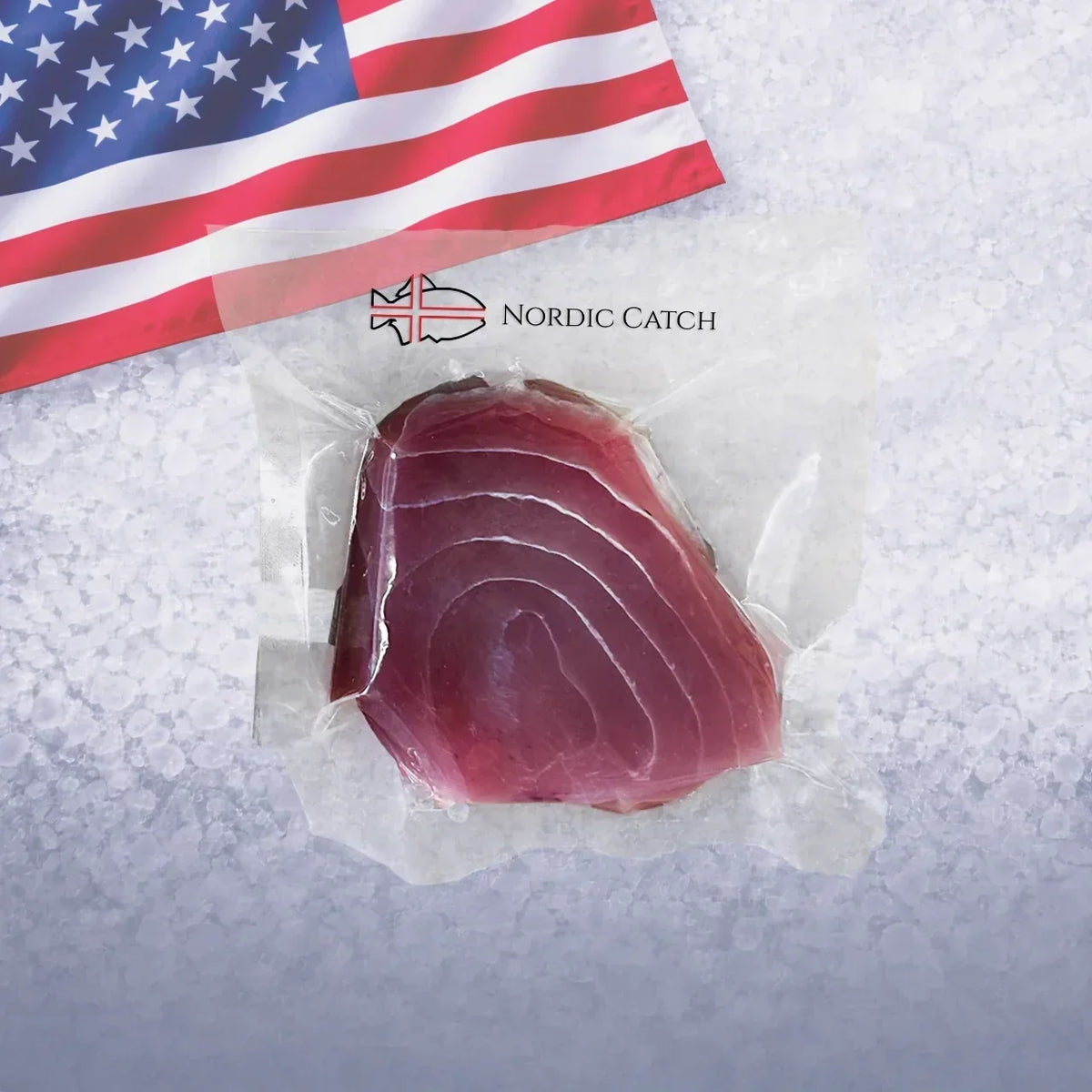
Our Fresh Ahi Tuna Steak (Yellowfin) is the steak this recipe was written around. It is wild-caught in the Central Pacific, cut as a single 12oz portion, graded #1, and shipped fresh, never frozen. It is also untreated: no carbon monoxide, no tasteless smoke to lock in a red color. That matters because untreated tuna tells you the truth about its age. A fresh piece reads deep ruby to garnet with a slight sheen and smells of clean seawater. If it is dull, browning at the edges or weeping liquid in the bag, it has sat too long, and a color-treated steak would hide all three signals behind a permanent cherry red. Our guide to telling whether seafood is fresh runs the same checks for every species we ship.
The two finishes here share one technique. The sesame way presses a white and black sesame crust onto the steak and serves it with a soy, ginger and rice vinegar dipping sauce; it is what most people picture when they hear seared ahi. The pepper way coats the steak in coarsely cracked black pepper and finishes it with lemon and good olive oil, closer to how tuna is treated around the Mediterranean, where it was a steak long before it was sushi. Both need a dry pan hot enough to smoke, both take 45 to 60 seconds a side on a steak at least an inch thick, and both come off with a center that would read 110 to 115F.
Make this when you want a restaurant plate in fifteen minutes, sauce included. It is best the day the box arrives, and our yellowfin is meant to be eaten within three days of delivery. Frozen tuna still sears well once thawed, though untreated tuna darkens in the freezer and the slices will look maroon rather than ruby; the flavor is fine, the photographs are not. And if someone at the table wants their tuna cooked through, cook it through. Take it to 145F, the temperature the FDA recommends for fish, and accept that it will be firmer and drier. It is their dinner.
Nutrition
Yellowfin is one of the leanest proteins in the ocean. A 6oz raw steak carries about 41 grams of protein and under a gram of fat, which is why tuna sits near the top of our list of the highest-protein seafoods. In the sesame way, the fat and the carbohydrates arrive with the seeds and the searing oil, and most of the sodium arrives with the soy sauce, so a low-sodium soy cuts that figure nearly in half. The pepper way trades sesame fat for olive oil and lands within a few calories of the same total. The figures below are for the sesame way, built from USDA FoodData Central values for raw yellowfin plus standard values for the seeds, oil and sauce. Estimated values per serving:
| Fats | % DV* |
| Total Fat 17g | 22% |
| Saturated 2.5g | 13% |
| Trans 0g | |
| Polyunsaturated 5.5g | |
| Monounsaturated 8g | |
| Cholesterol 65mg | 22% |
| Sodium 1,240mg | 54% |
| Carbs, Protein and Micronutrients | % DV* |
| Total Carbohydrate 8g | 3% |
| Dietary Fiber 2g | 7% |
| Total Sugars 3g | |
| Protein 45g | 90% |
| Selenium 160mcg | 290% |
| Vitamin B12 3.5mcg | 146% |
| Potassium 810mg | 17% |
Ingredients
- 1 (12oz) Fresh Ahi Tuna Steak (Yellowfin), sushi grade, cut into 2 steaks of even thicknessFeatured
- 1 tbsp Neutral high-heat oil, such as avocado or grapeseed
- 1/2 tsp Kosher salt
- 3 tbsp Sesame seeds, white and black mixed (sesame way)
- 2 tbsp Soy sauce, plus 2 tsp rice vinegar and 1 tsp honey, for the dipping sauce (sesame way)
- 1 tsp each Grated fresh ginger and toasted sesame oil, plus 1 scallion, thinly sliced (sesame way)
- 1 1/2 tbsp Black peppercorns, coarsely cracked (pepper way)
- 1 lemon Cut in wedges, plus 2 tbsp extra-virgin olive oil and flaky sea salt to finish (pepper way)
Preparation
Everything about this recipe happens fast, so the preparation is where the work is. Take the tuna out of the fridge 15 minutes before cooking, and no longer. A steak that is fridge-cold at the center will stay that way through a 90-second sear, which is what you want; a steak that has sat out for an hour starts to cook through from the edge before it ever touches the pan. Open the vacuum pack, lift the steak onto paper towels and pat every surface dry, then let it sit on fresh towels while you work. Water on the surface turns to steam in a hot pan, and steam cannot brown anything. If your 12oz portion is one long piece, cut it crosswise into two steaks of even thickness. Even thickness is worth more than even weight here, because thickness is what sets the timing.
Make the sauce or cut the lemon before the pan goes on. Once the fish is in, you will not have a free hand or a spare second. Then set up your station:
- Whisk the soy sauce, rice vinegar, honey, ginger and sesame oil in a small bowl and stir in the scallion.
- Spread the sesame seeds on a plate wide enough to hold a steak flat, or crack the peppercorns coarsely under the base of a heavy pan.
- Season the steaks on all sides with the kosher salt and let them sit 5 minutes.
- Cut the lemon into wedges and set the olive oil and flaky salt beside the stove.
- Put a cutting board, a thin sharp knife and a cold resting plate within reach of the pan.
- Turn on the vent fan and open a window; a dry pan at searing heat will smoke.
How to Cook
The pan does the cooking, so choose the right one. Cast iron or carbon steel holds its heat when cold fish lands on it; a thin nonstick pan drops temperature on contact and should not be pushed to the heat this needs. Of all the ways to cook fish, this is the fastest and the least forgiving, because the window between a raw center and a cooked one is about 30 seconds. Set a timer. Do not trust your eye on the first steak, since the crust looks finished before the heat has traveled as deep as you want it to.
-
Heat the pan dry
Set a heavy skillet over high heat with nothing in it and give it a full 3 to 4 minutes. It is ready when a drop of water skitters across the surface and vanishes on contact. Only then add the oil, swirl it once and wait for the first wisp of smoke. Oil added to a cold pan burns before the pan is hot enough, so the fish lands on bitter oil and a surface too cool to crust.
-
Build the crust
This is where the two ways part. For the sesame way, brush the steaks with a thin film of the dipping sauce so the seeds have something to grip, then press each face and side into the seeds until they hold in one even layer. For the pepper way, press the steaks into the cracked pepper the same way, sides included, and add a last pinch of salt. Work quickly so the fish stays cold, and shake off loose crust, which will scorch before the steak is done.
-
Sear 45 to 60 seconds a side
Lay the steaks in the pan away from you and leave them alone. Count 45 seconds for a 1-inch steak and 60 for anything thicker, then turn with tongs and repeat; give each edge 10 to 15 seconds if you want crust all the way around. Sesame is done when it is golden and popping, pepper when it smells toasted and a little sweet. On the cut edge you should see a pale band no deeper than a quarter inch creeping in from each face.
-
Rest, then slice thick
Move the steaks to a cold plate for 2 to 3 minutes and do not tent them. Resting sets the crust so it does not fall off under the knife, and the center will read 110 to 115F: cool, deep ruby and soft to the touch, inside a firm cooked rim you can both see and feel. Slice across the grain into half-inch pieces, one pulling stroke per slice. Sawing back and forth shreds the raw center and knocks the crust loose.
How to Serve
Fan the slices on a warm plate so the ruby cross-section faces up, because that cross-section is the whole point of the dish. Serve the sesame way with the dipping sauce in a small bowl on the side rather than poured over the fish; the crust goes soft in under a minute once it is sauced. Serve the pepper way with lemon wedges, a thread of your best olive oil across the cut faces and a few flakes of sea salt.
- Slice just before serving. Cut tuna oxidizes at the surface and starts to brown within 20 minutes.
- On the pepper way, squeeze the lemon over the slices, not the crust, so the pepper stays crunchy.
- Warm the plates and keep the fish cool. The contrast between a warm crust and a cold center is the texture you are after.
What to serve it with. Keep the sides quiet, since the fish is the loud part of the plate:
- Steamed short-grain rice and quick-pickled cucumber with the sesame way
- A shaved fennel and orange salad with the pepper way
- Blistered green beans or snap peas tossed with a little sesame oil
- Crusty bread and a bowl of good olive oil for dragging through the lemon and pepper drippings
Seared tuna keeps for one day, not two. Wrap any unsliced steak tightly in plastic, refrigerate it right away and use it within 24 hours; the raw center is still raw fish, and the clock has been running since the box arrived. Do not reheat it. Warmed-over seared tuna is cooked tuna, and cooked tuna is a different, drier dish. Instead, slice the cold steak thin and treat it the way a sushi bar treats tataki: over rice with the leftover dipping sauce, in a salad with the lemon and oil, or tossed with cubed avocado and scallions. Our notes on storing seafood in the fridge and freezer cover the general rules.


