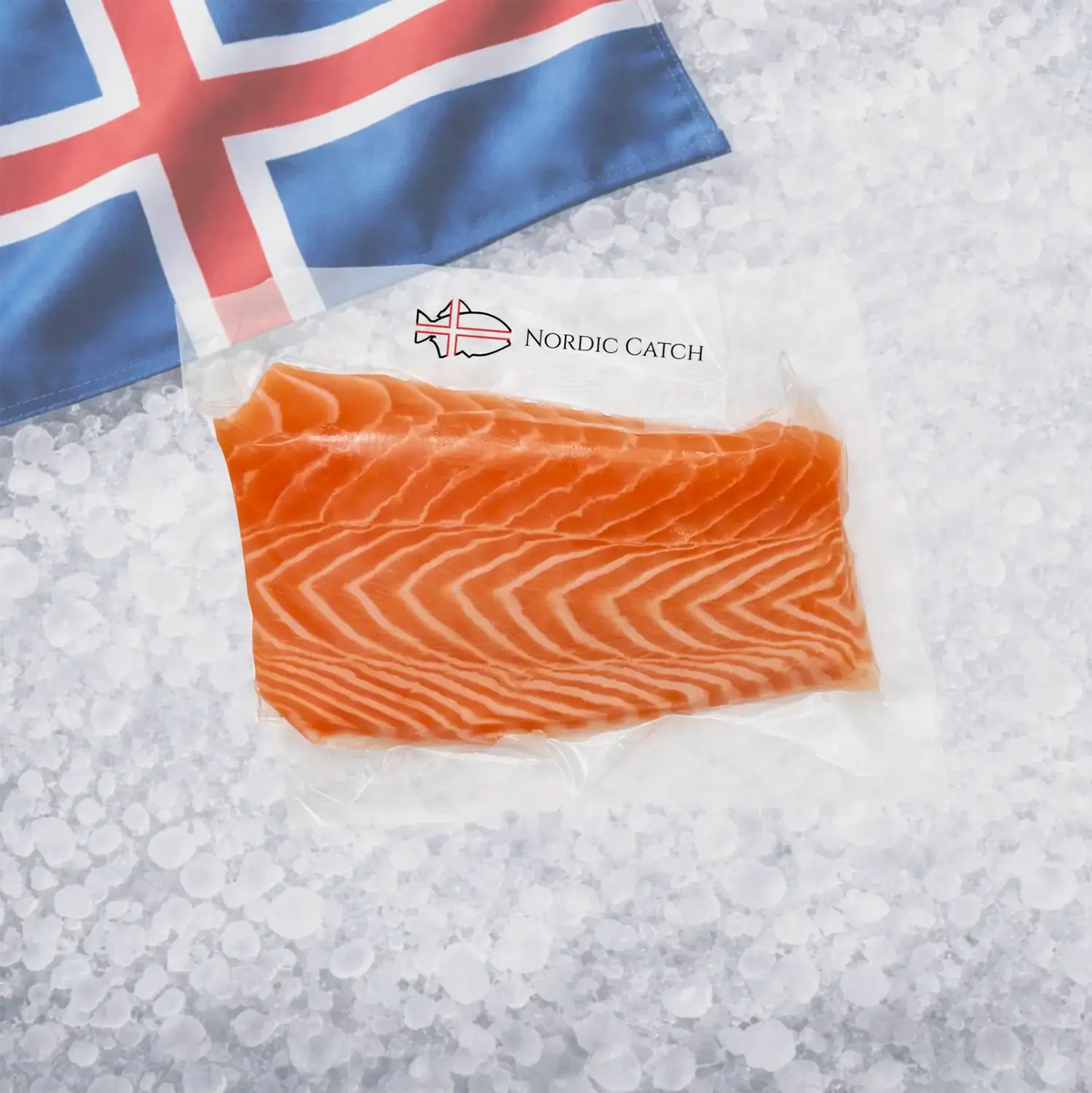
Salmon is the fish most people learned to eat raw, which is why salmon crudo so often falls flat. The fish is rich and mild. A dressing built for lean white fish, mostly lemon and oil, slides off it and tastes of little. Salmon needs an edge. Yuzu kosho brings three at once, citrus peel, green chili and a good deal of salt, in a paste so concentrated that one teaspoon seasons a platter.
We build it on our Salmon Loin, Sashimi Ready from Iceland, $32 for a skinless portion that averages 9 oz. Its product page lists Icelandic Atlantic salmon from the center and belly of the fillet, picked for marbling, with crudo among its uses. The paste is our green Yuzu Kosho, $14 for a 2 oz jar made in Japan. Add one lemon, a good olive oil and a pinch of Icelandic flake salt.
Raw salmon safety does not come from the words sushi grade, a label the FDA does not define or award. The rules for shops and restaurants that serve fish raw sit in section 3-402.11 of the FDA Food Code. Fish sold or served raw must first be frozen to destroy parasites, at -4F or below for 7 days or on one of two colder schedules, unless it is exempt. One exemption is written with salmon in mind: aquacultured fish raised in net-pens or land-based tanks and fed formulated feed, such as pellets, that contains no live parasites. Under section 3-402.12, the business serving it keeps a written statement from the supplier or farm saying so (FDA Food Code 2026). Our salmon is farmed; our FAQ says it comes from several Icelandic farms, land-based operations among them, and adds that feed varies by producer, so the word farmed alone does not prove the exemption applies. Two FDA cautions still apply: freezing spares some harmful germs, so keep the cold chain unbroken, and pregnant women, children, older adults and anyone with a weakened immune system should not eat raw fish (FDA).
Plan on 35 minutes, 20 of them hands-off, plus an overnight thaw if the loin is frozen.
Salmon Crudo Nutrition per Serving
Crudo is mostly fish and oil. Every figure here is our own math on USDA FoodData Central entries (FoodData Central): farmed Atlantic salmon, raw, at 208 calories, 20.4 grams of protein and 13.4 grams of fat per 100 grams, plus olive oil, lemon juice and chives. USDA has no generic yuzu kosho entry, so we used the saltier of two brand labels filed there, 7,800 mg of sodium per 100 grams against 4,400, and counted the finishing flakes as table salt. Each of the four servings carries about 2 1/4 oz of salmon and its share of dressing. Treat it as an estimate; the fat in your loin and the dressing left on the plate will move every number.
| Fats | % DV* |
| Total Fat 15g | 20% |
| Saturated Fat 2.9g | 14% |
| Monounsaturated Fat 7.3g | |
| Polyunsaturated Fat 3.2g | |
| EPA + DHA (omega-3) 1.25g | |
| Cholesterol 35mg | 12% |
| Carbs, Protein & Micronutrients | % DV* |
| Total Carbohydrate 0.3g | 0% |
| Dietary Fiber 0g | 0% |
| Protein 13g | 26% |
| Sodium 210mg | 9% |
| Potassium 240mg | 5% |
| Selenium 15mcg | 28% |
| Vitamin B12 2.1mcg | 86% |
| Vitamin D 7mcg | 35% |
Sodium stays modest for a seasoned raw plate, about 210 mg a serving, and nearly half of it comes from one teaspoon of yuzu kosho, which is why the flakes go on last and lightly. By the same USDA entry, the salmon supplies roughly 1.25 grams of the omega-3s EPA and DHA per serving and 7 micrograms of vitamin D, about a third of the Daily Value.
Salmon Crudo Ingredients
A salmon crudo recipe has nowhere to hide a weak ingredient, so the list is short. Any of our sushi grade salmon will work, but the sashimi-ready loin is the cut we reach for: skinless, evenly thick through the center, and marbled enough that a thin slice stays soft. Yuzu kosho is the seasoning, the heat and most of the salt in one spoon. Use a fruity extra-virgin olive oil and a real lemon; bottled juice tastes flat beside the paste. The finishing salt on our plates is Umami Sea Salt Type 02 Unnur, $15, Icelandic flakes mixed with sugar kelp and pitched on its page for seafood and vegetables.
- 1 loin (9 oz) Salmon loin, sashimi ready, skinless, kept at 40F or belowFeatured
- 1 tsp Yuzu kosho, greenFeatured
- 1 tbsp Fresh lemon juice, plus 1/2 tsp finely grated zest
- 2 tbsp Extra-virgin olive oil, fruity rather than peppery
- 1/8 tsp Flaky sea salt, such as Umami Sea Salt Type 02 Unnur
- 1 tbsp Chives, sliced very thin
- To serve Thin toasted bread or plain rice crackers, optional
Thaw a frozen loin the night before, still sealed, on a plate low in the refrigerator; its product page asks for a slow thaw under refrigeration and says to eat the fish soon after opening. A chilled loin follows the FDA rule for fresh seafood: refrigerate it at 40F or colder for no more than 2 days, or freeze it the day it arrives, as the loin's page advises (FDA). Keep the bag sealed until step 1. Before the fish comes out:
- Thaw a frozen loin overnight in the refrigerator, still in its bag.
- Chill four flat plates, rimmed if you have them, so the dressing pools.
- Fill a mixing bowl with ice and cold water for step 1.
- Juice and zest the lemon; put the juice and the yuzu kosho in a small bowl, the oil in another.
- Cut the chives into the thinnest rings you can manage; keep them on a damp paper towel.
- Hone your longest knife; set a damp towel under the board.
How to Prep Sushi Grade Salmon for Crudo
Crudo slices run thinner than salmon sashimi and are cut at a lower angle, so they lie flat and show a wide face to the dressing. That asks more of the fish. Sushi grade salmon straight from the refrigerator is soft enough that a thin slice tears and its fat smears on the blade. Fix the temperature first, then the direction. Two 5.5 oz portions of our Icelandic salmon for sashimi, $16 each, can stand in for the loin once any skin is trimmed off; you get 11 oz, the method holds, and the plates get a little more generous.
-
Chill the Loin Until Firm
Lower the sealed bag into the bowl of ice water and weigh it down with a small plate so the whole loin sits under the surface. Leave the bowl in the refrigerator for 20 minutes. Ice water chills fish faster than cold air and firms the fat without freezing the surface. Cut the bag open, lift the loin onto paper towels and pat every face dry. Run a fingertip down the center line; if you feel the tip of a pin bone, pull it with tweezers in the direction it points. The loin is ready when it feels firm under your thumb and the white lines look matte, not glossy.
-
Slice Against the Grain
Those white lines are thin sheets of fat and connective tissue between blocks of muscle, and they are the grain. Turn the loin so the lines run diagonally away from you. Hold the knife at about 30 degrees to the board and slice across the lines, drawing the whole blade through in a single stroke, about 1/8 inch thick, so each piece shows a fan of white stripes. Do not saw; a back-and-forth stroke crushes the flesh, and on salmon it shows. Wipe the blade every few slices. Lay the pieces on the chilled plates as you go, overlapping in one layer, five or six to a plate, and refrigerate each plate while you cut the next. Chop the uneven end pieces and keep them cold for a rice bowl later that day.
How to Make Yuzu Kosho Dressing
Our green citrus chili paste is yuzu kosho in its classic form: yuzu zest, green chili and salt, ground together. Its product page calls it more aromatic than spicy, and on salmon the citrus lands first, the chili a moment later. This yuzu kosho recipe makes the paste the base of a dressing, not a garnish. A dab on each slice gives some bites all heat and others none; dissolved into lemon and oil, one teaspoon reaches every piece. Most crudo recipes stop at oil and lemon; the paste is what this crudo recipe adds.
-
Whisk the Yuzu Kosho Into Citrus & Oil
Stir the teaspoon of yuzu kosho into the lemon juice with a fork until no lumps remain, about 30 seconds. Salt dissolves in juice, not oil, which is why the citrus goes in first. Pour in the olive oil in a thin stream, whisking, until the dressing turns cloudy and slightly thick. Taste it on a scrap of salmon. It should be bright and salty, with heat that builds and fades. If it tastes harsh, whisk in another teaspoon of oil. The dressing holds for an hour in the refrigerator; whisk it again before using.
-
Spoon Over the Salmon & Finish With Salt
Dress the plates at the last minute. Lemon juice firms and clouds the surface of raw fish within minutes, and the salt in the paste pulls out moisture, so an early plate goes from glossy to dull before anyone eats. Divide the dressing among the four plates, a little under a tablespoon each, and let it run between the slices. Scatter the chives and lemon zest. Salt goes on last: crumble a few flakes from our Icelandic sea salts over each plate with a light hand, since the yuzu kosho has already seasoned the fish. Serve at once.
How to Serve Raw Salmon Crudo
Crudo is a first course, and a small one. Serve it cold, on cold plates, with thin toasted bread, rice crackers or nothing at all. Four ways to build on the base recipe:
- With cucumber. Paper-thin ribbons of English cucumber under the slices add crunch and cut the richness.
- With grapefruit. Tuck a few pink grapefruit segments between the slices and halve the lemon juice. The bitterness suits fatty salmon.
- Over rice. Spoon the chopped end pieces over warm seasoned rice with the dressing and a little torn nori.
- As a platter. For six or more, double the recipe, lay the slices on one large chilled platter and dress it in front of guests.
Raw salmon recipes share one rule about time: hold the fish at 40F or below until the plates go out. The FDA's limit for seafood left out is 2 hours, or 1 hour above 90F, and for a party it advises setting cold seafood on ice if it will be out longer (FDA). For a bigger spread, our yellowtail hamachi crudo uses the same thin slices with a lemon, lime and jalapeno finish. Dressed salmon does not keep; undressed slices, covered and cold, can wait until later the same day.