The fish in a chirashi bowl gets the photographs, and the rice decides whether anyone finishes it. Underseasoned sushi rice tastes like plain rice under expensive fish, and hot rice dulls the salmon. Seasoned at the right moment and cooled, it carries soy, wasabi and roe to the last bite. Slicing is the easy half.
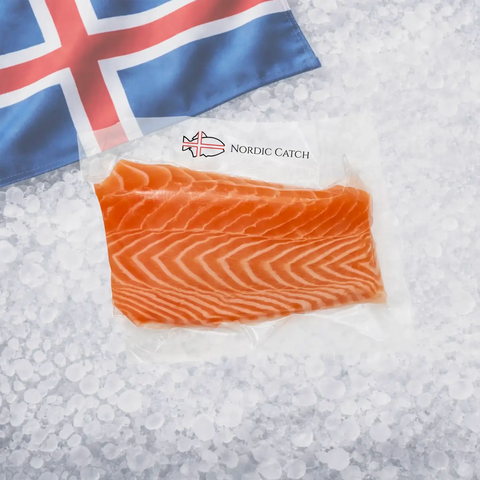
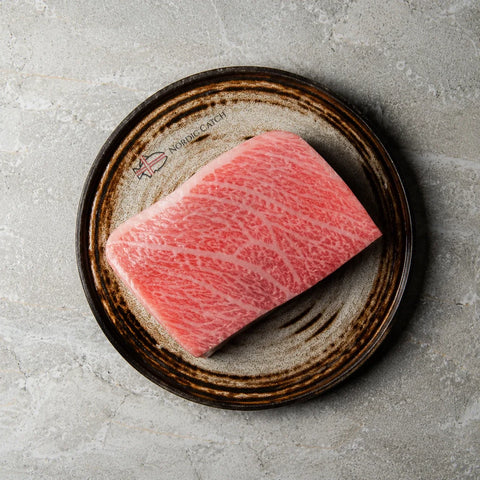
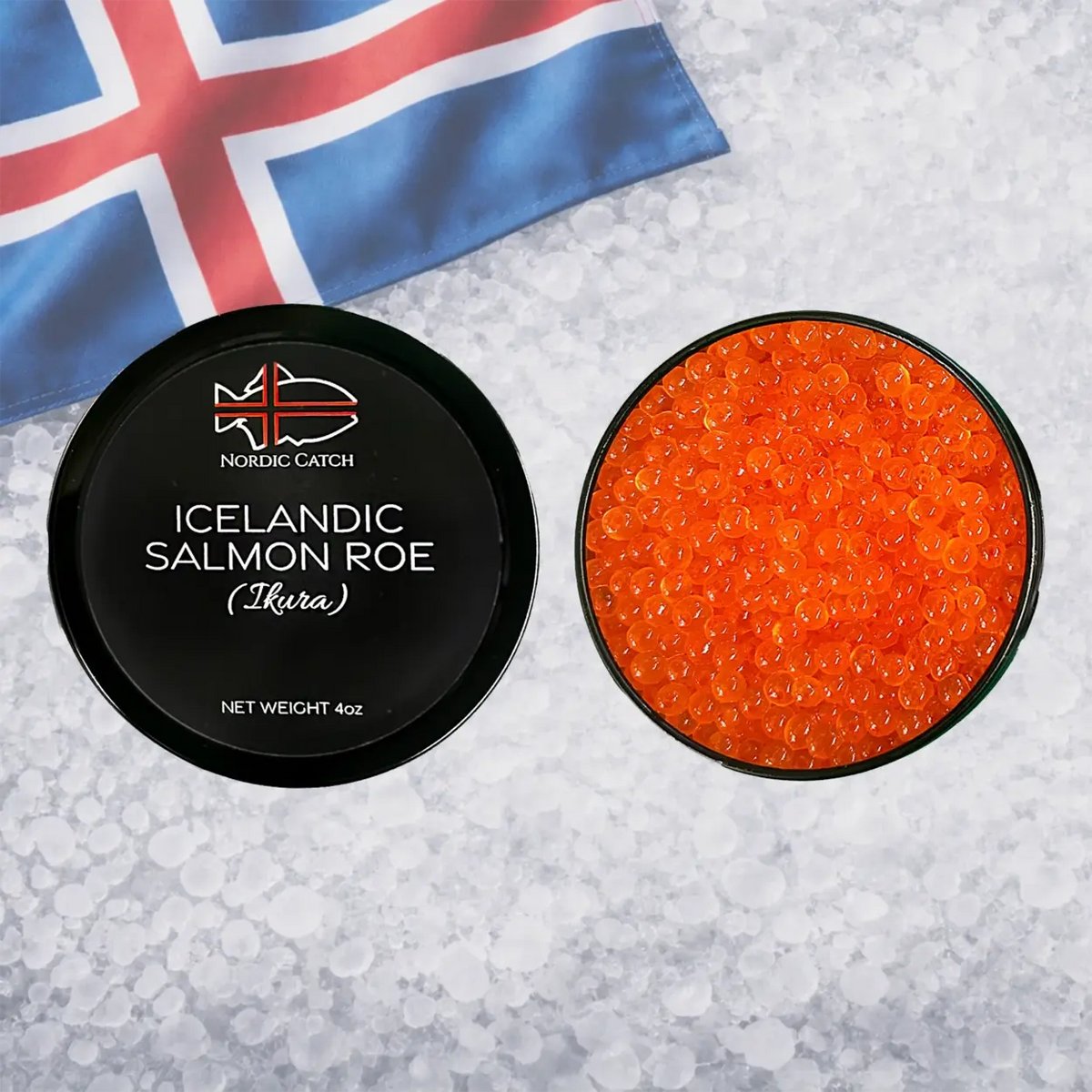
Chirashizushi means scattered sushi: vinegared rice in a bowl, topped with raw fish and garnishes (Wikipedia). Ours uses two 5.5 oz portions of our Salmon, Sushi Grade from Iceland at $16 each, one Wild Ahi Tuna Sushi Saku Block of AAA grade yellowfin, 10 oz average, $19, and one 3.5 oz tub of our lightly salted Icelandic Salmon Roe (Ikura), $65. Each of the four bowls gets about 5 1/4 oz of fish and 1 1/2 tablespoons of roe, close to $29 in seafood.
Thaw the frozen saku block in the refrigerator the night before. On the day, allow about 1 hour 20 minutes, mostly rice cooking and cooling while you slice.
Chirashi Don Nutrition per Serving
These chirashi don figures come from USDA FoodData Central entries (FoodData Central) for raw farmed Atlantic salmon and yellowfin, dry short-grain rice, seasoning and toppings. With no salmon roe entry in SR Legacy, ikura counts as the closest salted roe, black and red granular caviar. Each bowl is a quarter of the recipe, without table soy, and every figure is an estimate.
| Fats | % DV* |
| Total Fat 17g | 22% |
| Saturated Fat 4g | 19% |
| Monounsaturated Fat 4.7g | |
| Polyunsaturated Fat 5.6g | |
| EPA + DHA (omega-3) 3.2g | |
| Cholesterol 215mg | 72% |
| Carbs, Protein & Micronutrients | % DV* |
| Total Carbohydrate 67g | 24% |
| Total Sugars 5g | |
| Protein 45g | 90% |
| Sodium 1,030mg | 45% |
| Potassium 770mg | 16% |
| Selenium 100mcg | 182% |
| Vitamin B12 9mcg | 373% |
Watch the sodium: about 1,030 milligrams a bowl before any soy, more than half from the rice salt and about 370 from the roe. Each teaspoon of shoyu adds roughly 290 more, and cutting the rice salt to 3/4 teaspoon saves about 145. Salmon and roe also bring about 3.2 grams of the omega-3s EPA and DHA.
Chirashi Bowl Ingredients
A chirashi bowl is only as good as its rice and its coldest fish. Half this list is pantry. Everything else is what we ship: pale orange salmon, deep red tuna and bright orange roe. Toppings stay small: a sheet of our Kimnori organic sushi nori, $8 for 10 sheets, with cucumber, scallion and sesame. Chirashi sushi takes wasabi and soy on the side, never stirred into the rice.
- 2 portions (5.5 oz each) Salmon, Sushi Grade from Iceland, kept coldFeatured
- 1 block (10 oz avg) Wild Ahi Tuna Sushi Saku Block, thawed overnightFeatured
- 1 tub (3.5 oz) Icelandic Salmon Roe (Ikura), kept coldFeatured
- 1 1/2 cups Japanese short-grain rice
- 1 1/2 cups + 2 tbsp Cold water
- 1/4 cup Rice vinegar, such as Kikkoman Original
- 1 1/2 tbsp Sugar
- 1 tsp Fine sea salt
- 1 sheet Nori, cut into thin strips
- 1 small Cucumber, Persian or English, sliced thin
- 2 Scallions, sliced thin
- 1 tbsp Toasted sesame seeds
- To serve Wasabi, soy sauce and pickled ginger
Our saku block's page says to keep it frozen until needed, thaw it slowly under refrigeration and use it promptly once thawed. So the night before, set it on a rimmed plate on the lowest shelf of the refrigerator, the overnight thaw the FDA advises for frozen seafood, with any roe that came frozen.
On the day, before any fish comes out:
- Rinse the rice and leave it to drain.
- Warm the vinegar, sugar and salt over low heat until clear.
- Cut the nori into thin strips and slice the cucumber and scallions.
- Set out four bowls and chill a plate for the sliced fish.
- Wet and wring out a clean towel for the rice.
How to Season Sushi Rice for Chirashi
Sushi rice seasoning is three ingredients and one piece of timing. Vinegar goes on while the rice still steams and the grains take it in; on cooled rice it pools and turns sticky. We use Kikkoman rice vinegar, the Original bottle, $7 for 10 oz, with sugar and salt measured by hand. Kikkoman's Seasoned bottle, also $7, already carries sugar and salt, and its page lists sushi rice among its uses. With that one, skip the sugar and salt and add the vinegar a tablespoon at a time, tasting.
-
Rinse & Cook Short Grain Rice
Cover the rice with cold water, swirl it and pour off the cloudy water. Repeat four or five times, until the water is only faintly cloudy; loose surface starch makes sushi rice gummy. Drain it in a sieve for 15 minutes. Bring it to a boil in a heavy 2 quart pot with 1 1/2 cups plus 2 tablespoons of cold water, cover, turn the heat to its lowest and cook 15 minutes without lifting the lid. Off the heat, leave it covered 10 minutes more. A rice cooker works too: fill to the sushi line, a little less water than plain rice gets, since the seasoning adds liquid later.
-
Fold in Vinegar, Sugar & Salt
Spread the hot rice in a wide wooden or glass bowl. Pour the warm seasoning over a rice paddle held above it so it falls evenly, then cut and fold: slice the paddle down through the rice at an angle, lift, turn, and work across the bowl for about a minute. Stirring in circles mashes the grains. Fan the rice with cardboard as you fold to drive off steam and give it a gloss. A few grains should taste bright, a little sweet and clearly salted. Cover with the damp towel until it feels no warmer than your hand, about 20 minutes, and keep it out of the refrigerator, where the grains turn hard.
How to Slice & Arrange the Sashimi Bowl
Good chirashi looks scattered on purpose: fish in overlapping fans, each kind in its own patch, roe at the center. Treat it as a sashimi bowl with three rules. Slice cold, arrange fast, and add the ikura last.
For salmon we use our Icelandic salmon for sashimi, a 5.5 oz vacuum-sealed portion of Atlantic salmon. For tuna, our wild ahi saku, trimmed AAA grade yellowfin whose color, its page says, is held by a tasteless smoke process. And for roe, our Icelandic salmon roe ikura.
Sushi grade salmon is a marketing term, on our labels and everyone else's; the FDA neither defines nor assigns it. Raw safety comes from species, how a fish was raised or frozen, and how cold it stayed. Section 3-402.11 of the FDA Food Code 2026 has restaurants and stores freeze fish served raw, for example 7 days at -4F, then lists exceptions. Two can apply to this bowl: "Thunnus albacores (Yellowfin tuna)," as the code spells it, and "FISH eggs that have been removed from the skein and rinsed." A third covers farmed fish such as salmon raised in net-pens or tanks on formulated feed that contains no live parasites, with a supplier's written statement on file under section 3-402.12. Our salmon page describes Icelandic aquaculture; our ikura page does not describe how its pearls are processed. Fresh on a label is not a parasite control, so ask any seller of raw farmed salmon, us included, how it was raised and fed or whether it was frozen.
Per the FDA seafood safety guide, freezing kills parasites but not every harmful germ, so hold everything at 40F or below until the bowls are built. The same page says who should skip raw fish: pregnant women, children, older adults, and transplant patients or others whose immune systems are weakened. For them, cook the fish to 145F and skip the roe.
-
Cut Sushi Grade Salmon & Tuna
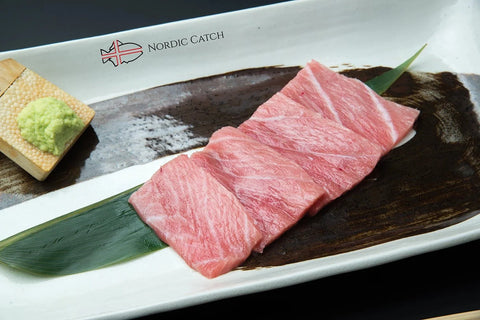
Slice one fish at a time and keep the other cold. Pat the salmon dry, turn it so the white fat lines run left to right, and slice across them at a slight angle, about 1/4 inch thick, drawing the whole blade through each cut in one stroke. Sawing tears soft fish. Expect about six slices per bowl. Ahi is leaner and firmer: blot it dry and slice it across the grain a little thicker, about 3/8 inch, four or five slices per bowl. Lay the slices on the chilled plate, cover, and refrigerate until the rice cools.
-
Spoon the Salmon Roe On Last
Divide the rice among four bowls, about 1 cup each, and level it lightly without packing. Scatter the nori over it. Fan the salmon over one side of each bowl and the tuna over the other, each slice leaning on the last, then tuck in the cucumber and scatter the scallions and sesame. Now open the roe. Set about 1 1/2 tablespoons in the center of each bowl with a cold spoon, without pressing. Pressed pearls burst and leak brine, and roe on warm rice goes soft, so it goes on just before serving. Add wasabi to each bowl and soy in small dishes.
How to Serve Kaisendon at Home
Call it chirashi or kaisendon. In Japan, kaisendon is the seafood rice bowl, thinly sliced sashimi over rice, sometimes with fish roe (Wikipedia), so ours on sushi rice answers to both. Serve it the moment it is built, rice at room temperature and fish still cold. A sushi bowl needs little beside it:
- Soy in a small dish per person. Dip the fish, not the rice, which soaks it up and falls apart.
- Wasabi on the side, from a tube or from our fresh Japanese wasabi root, $125, grated to order.
- Pickled ginger between bites, and miso soup if the meal needs to stretch.
- For a special night, a few slices of our Japanese hamachi from Kagoshima, from $75, or our Wild Hokkaido Shoyu Ikura, $59, already marinated in soy.
A finished kaisendon does not keep, since the rice hardens in the refrigerator and the fish weeps onto it, so build only the bowls you will eat.